Texas Jobsite Injury Claims
Forklift Accidents on Texas Jobsites: Third-Party Liability
A forklift accident may involve more than workers’ compensation. In some cases, another company may also be responsible.
Forklifts are common on Texas jobsites, warehouses, construction sites, industrial facilities, loading docks, refineries, plants, and distribution centers.
```They help move heavy materials quickly. However, when something goes wrong, the injuries can be serious.
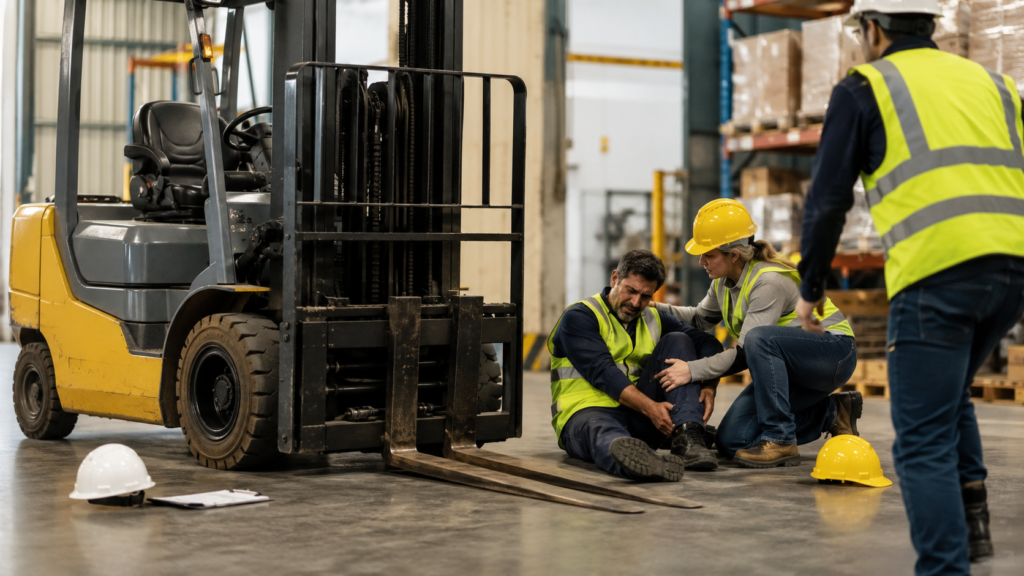
A forklift accident may involve a worker being struck, pinned, crushed, run over, knocked from an elevated surface, or injured by a falling load.
```After a forklift injury, many workers hear the same thing: that is just workers’ comp. However, that is not always the full story. If someone other than the injured worker’s employer contributed to the accident, there may be a third-party injury claim. That can matter because a third-party claim may allow an injured worker to seek damages that are not always available through workers’ compensation alone. The Law Office of Don McClure helps injured Texans understand their legal options after serious worksite accidents, including cases involving forklifts, contractors, subcontractors, equipment companies, and third-party negligence.
Quick Answer: Can a Third Party Be Responsible for a Forklift Accident in Texas?
```Yes, depending on the facts. A forklift accident on a Texas jobsite may involve third-party liability if someone other than the injured worker’s employer caused or contributed to the accident.
Potential third parties may include a subcontractor, general contractor, property owner, forklift rental company, maintenance company, loading company, delivery company, equipment manufacturer, or another company working at the site.
The key question is whether another person or company had a role in creating, controlling, or failing to correct the dangerous condition that caused the injury.
```Why Forklift Accidents Happen on Texas Jobsites
Forklifts, also called powered industrial trucks, are used to move, lift, lower, and stack materials. The Occupational Safety and Health Administration explains powered industrial trucks as equipment commonly used across many industries to move materials and handle loads.
Because forklifts often operate near workers, vehicles, materials, and tight spaces, accidents can happen quickly.
Common causes of forklift accidents may include:
- Unsafe operation
- Poor visibility
- Improper loading
- Unstable loads
- Excessive speed
- Lack of training
- Defective equipment
- Poor maintenance
- Unsafe traffic flow
- Congested work areas
- Missing spotters
- Failure to separate pedestrians from equipment
- Forklift tip-overs
- Loading dock hazards
A forklift may be operated by one company while workers from another company are nearby. For that reason, these cases can become legally complicated.
Why Forklift Accidents May Involve More Than Workers’ Compensation
Workers’ compensation may apply when an employee is injured while working. However, workers’ compensation does not always answer every legal question after a forklift accident.
A separate third-party claim may exist if another company, contractor, equipment provider, property owner, or manufacturer contributed to the injury.
For example, a worker may be injured at a construction site where multiple companies are working at the same time. If a subcontractor’s forklift operator runs over another company’s worker, that injured worker may have a third-party claim against the subcontractor.
Another example may involve a forklift rental company that provides poorly maintained equipment. If the equipment fails during use and causes an injury, the rental or maintenance company may need to be investigated.
In other words, a work injury is not automatically limited to workers’ compensation just because it happened on the job.
Who May Be a Third Party After a Forklift Accident?
Several parties may need to be investigated after a serious forklift accident. In some cases, more than one company may share responsibility.
Subcontractors
Many Texas jobsites involve several subcontractors working in the same area. If one subcontractor creates a hazard that injures another company’s worker, third-party liability may apply.
Examples may include a subcontractor operating a forklift unsafely, leaving materials in a travel path, failing to secure a load, or ignoring site safety rules.
General Contractors
A general contractor may be responsible for certain site safety practices depending on control, contracts, and the facts of the case.
Important questions may include who controlled the work area, who handled site traffic, who created the safety plan, who had authority to correct hazards, and whether forklift and pedestrian areas were separated.
Property Owners
A property owner may be involved if the accident was connected to unsafe premises conditions, poor site layout, dangerous loading areas, or known hazards.
Examples may include unsafe loading docks, poor lighting, dangerous ramps, bad flooring surfaces, unmarked pedestrian zones, or known traffic hazards.
Forklift Rental Companies
Many jobsites rent forklifts instead of owning them. If a rental company supplied defective or poorly maintained equipment, it may become part of the investigation.
Maintenance Companies
A forklift maintenance company may be involved if improper repairs, missed inspections, or negligent maintenance contributed to the accident.
Equipment Manufacturers
If a forklift defect contributed to the injury, the manufacturer or parts maker may be investigated.
Potential product issues may include brake failure, steering defects, stability problems, warning system defects, defective safety features, mechanical failure, or design defects.
Delivery or Loading Companies
Forklift accidents can also involve delivery trucks, loading docks, freight companies, or cargo handling businesses. For example, a loading company may be investigated if cargo was stacked, secured, or loaded improperly.
Examples of Third-Party Liability in Forklift Accident Cases
Third-party liability may arise in many different ways. For example:
- A subcontractor’s forklift operator strikes another worker.
- A delivery company blocks a safe pedestrian route.
- A rental company provides a forklift with faulty brakes.
- A maintenance company fails to repair a known mechanical issue.
- A property owner ignores a dangerous loading dock condition.
- A manufacturer sells a forklift with a defective safety system.
- A contractor fails to coordinate forklift traffic around other workers.
- A company allows untrained workers to operate forklifts near pedestrians.
- A loading company stacks materials in a way that causes them to fall.
However, these examples do not mean every forklift accident creates a third-party claim. Instead, the facts, contracts, control of the area, equipment condition, and witness statements all matter.
What Evidence Matters After a Forklift Accident?
Evidence can disappear quickly after a jobsite injury. For example, equipment may be repaired, moved, returned to a rental company, or placed back into service.
Important evidence may include:
- Incident reports
- OSHA reports
- Photos and videos of the scene
- Forklift inspection records
- Maintenance records
- Rental agreements
- Operator training records
- Forklift certification records
- Site safety plans
- Contractor agreements
- Witness statements
- Surveillance video
- Loading dock records
- Work orders
- Equipment manuals
- Prior complaints
- Safety meeting notes
- Traffic control plans
In addition, the OSHA powered industrial truck eTool provides training-related information on forklift operation and safety. This can help show why proper training, operation, and site procedures matter.
In serious cases, preserving the forklift itself may also be important.
Common Forklift Accident Injuries
Forklift accidents can cause severe and life-changing injuries.
- Crush injuries
- Broken bones
- Spinal cord injuries
- Head injuries
- Traumatic brain injuries
- Internal injuries
- Amputations
- Shoulder and knee injuries
- Severe lacerations
- Burns
- Wrongful death
NIOSH has published guidance for workers who operate or work near forklifts, emphasizing the importance of safety programs, training, operator licensing, and understanding forklift stability risks.
When injuries are serious, the long-term impact may include medical bills, lost income, future treatment, reduced earning capacity, and lasting pain.
What Should Injured Workers Do After a Forklift Accident?
After a forklift accident, the first priority is medical care. However, if a third party may be involved, it is also important to preserve information early.
- Report the accident to a supervisor and make sure the accident is documented.
- Get medical care, even if symptoms seem manageable at first.
- Identify who operated the forklift, what company employed the operator, who owned the forklift, who controlled the work area, and whether other contractors were nearby.
- Take photos if it is safe, including the forklift, load, work area, warning signs, lighting, loading dock, floor surface, and visible injuries.
- Get witness information from coworkers, contractors, delivery drivers, and nearby workers.
- Do not assume it is only workers’ compensation.
- Speak with a Texas work injury lawyer about whether another company contributed to the accident.
Can You Bring a Claim if You Were a Contractor?
Possibly, yes. Contractors, subcontractors, temporary workers, and employees of outside companies may have claims depending on how the accident happened.
In Texas, many jobsites involve multiple companies. As a result, it can be important to determine who controlled the forklift, who controlled the work area, and whether another company’s negligence caused the injury.
A contractor injured by another company’s forklift may have legal options beyond a workers’ compensation claim.
How the Law Office of Don McClure Can Help
Forklift accident cases can involve complex jobsite relationships. The company that employed the injured worker may not be the only party involved.
The Law Office of Don McClure helps injured Texans understand their rights after serious worksite accidents involving contractors, subcontractors, equipment companies, and other third parties.
Depending on the facts, legal help may include:
- Investigating the accident
- Identifying third parties
- Preserving equipment evidence
- Reviewing maintenance records
- Reviewing contractor agreements
- Gathering witness statements
- Communicating with insurance companies
- Evaluating whether a third-party injury claim may apply
If you were injured in a forklift accident in Houston, Pasadena, Baytown, or Southeast Texas, you may have questions about workers’ compensation, third-party liability, and your legal options.
FAQs About Forklift Accident Third-Party Liability in Texas
```It depends on who caused the accident. If a third party, such as another contractor, equipment company, or property owner, contributed to your injury, you may have a third-party claim.
No. Some forklift accidents involve workers’ compensation, but others may also involve third-party liability if someone outside the employer contributed to the accident.
A third party may include a subcontractor, general contractor, property owner, forklift rental company, maintenance company, loading company, or equipment manufacturer.
Important evidence may include photos, videos, incident reports, forklift maintenance records, operator training records, witness statements, contractor agreements, and safety plans.
If the forklift operator worked for another company, you may have a potential third-party claim against that company depending on the facts.
Be careful. Insurance companies may ask questions before the full investigation is complete. It may be helpful to understand your rights before giving detailed statements.
Final Thoughts
Forklift accidents on Texas jobsites can involve more than workers’ compensation. When another contractor, equipment company, property owner, maintenance provider, or manufacturer contributed to the injury, a third-party claim may be possible.
These cases often depend on evidence, including who controlled the work area, who operated the forklift, who owned the equipment, and whether safety rules were followed.
If you were injured in a forklift accident in Houston, Pasadena, Baytown, or Southeast Texas, the Law Office of Don McClure can help you understand your legal options.
Questions After a Forklift Accident on a Texas Jobsite?
The Law Office of Don McClure offers a free initial case review. You can discuss your situation, learn your options, and decide what steps may make sense for your case.
Contact UsExternal Sources
This article is for informational purposes only and does not constitute legal advice. Reading this article does not create an attorney-client relationship. Every case is unique, and past results do not guarantee future outcomes.