Why Rain Increases Car Accidents in Texas
Rain changes how vehicles handle and how drivers respond to traffic. When water builds up on the road, tires lose traction and braking becomes less effective. At the same time, visibility may drop, especially during heavier storms.
According to AAA wet weather driving guidance, even light rain can increase crash risk. Because of this, drivers must adjust immediately rather than continue driving as if conditions are normal.
Rain Car Accident Texas Liability: Drivers Must Adjust to Conditions
Under Texas law, drivers have a duty to operate their vehicles safely based on current conditions. This includes slowing down, maintaining a safe following distance, and staying alert to traffic changes.
The Texas transportation laws make it clear that failing to adjust to road conditions can still result in liability. In other words, even if it is raining, a driver may still be responsible if their actions contributed to the crash.
Because of this, rain car accident Texas liability often comes down to a simple question, did the driver act reasonably for the conditions?
Why Rain Is Not a Valid Legal Defense
Many drivers believe that bad weather removes fault. However, rain alone does not excuse unsafe driving.
Drivers are still required to maintain control of their vehicle. For example, if a driver is traveling too fast for wet conditions or following too closely, those actions may still be considered negligence.
Statements like “I could not stop because it was raining” do not automatically remove responsibility. Instead, the focus remains on whether the driver took reasonable steps to prevent the accident.
When Rain May Still Be Considered
While rain is not a full defense, it can still be part of the overall analysis. Wet roads may increase stopping distance, and reduced visibility may affect reaction time.
However, these factors are considered alongside driver behavior. In most cases, weather is only one piece of the puzzle, not the deciding factor.
Multi-Car Accidents in Rain Conditions
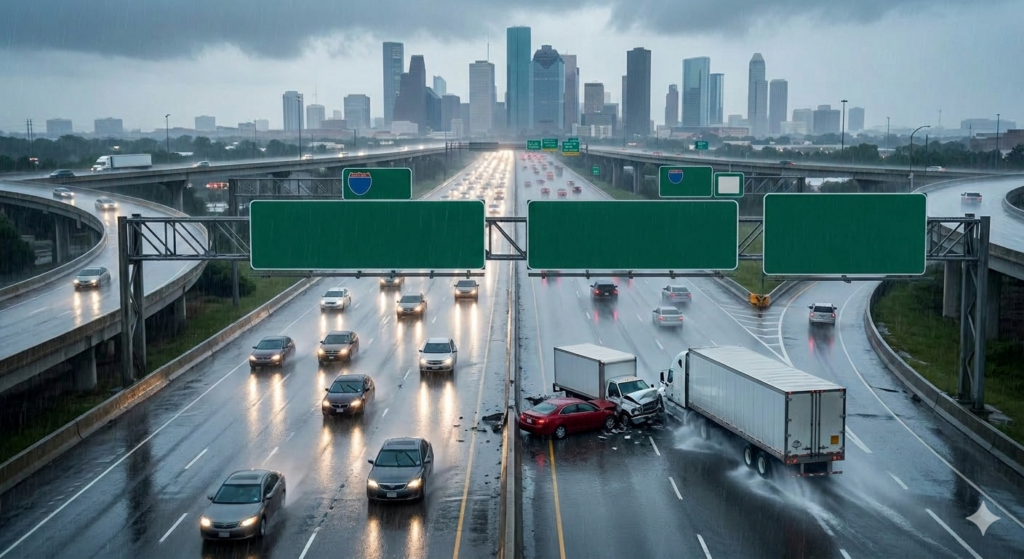
Rain often leads to chain-reaction crashes, especially on busy Houston highways. Traffic can slow quickly, and drivers who fail to adjust may not have enough time to react.
This is common on:
I-45
I-10
Loop 610
Beltway 8
In many situations, more than one driver may share responsibility. For example, one driver may brake suddenly, while another is following too closely. A third driver may then become involved.
These types of crashes are often seen in spring car accidents Houston drivers experience, where weather and congestion overlap.
How Rain Accidents Involve Trucks and Work-Related Drivers
Rain-related crashes often involve commercial vehicles or drivers working at the time of the accident. Trucks require more distance to stop, and wet roads can increase that distance even further.
In addition, delivery drivers or workers traveling between job sites may be under time pressure. Because of this, liability may extend beyond a single driver and may involve employers or commercial insurance policies.
You can also review how driving for work accident Texas claims may apply in these situations.
What to Do After a Rain-Related Car Accident
Taking the right steps after an accident can help protect both your health and your potential claim.
First, seek medical attention, even if injuries seem minor. Symptoms can appear later, and medical records are important.
Next, document the scene if possible. This includes photos of road conditions, weather, and vehicle damage. These details can be important in understanding how the accident happened.
It is also important to be careful when speaking with insurance companies. Avoid making statements about fault before you fully understand your situation.
Do You Have a Case?
Not every accident leads to a claim. However, you may have a case if another driver failed to adjust to weather conditions and caused the crash.
This may include situations where:
A driver was going too fast for the rain
A driver was following too closely
A commercial vehicle was involved
Each case depends on its specific facts, and a closer review is often needed.
What Your Case Could Be Worth
The value of a car accident claim depends on several factors, including medical expenses, lost income, and the severity of injuries.
Some cases may involve relatively modest compensation, while others may be more significant. However, it is important to understand that every case is different, and results are not guaranteed.
Talk to a Texas Car Accident Attorney
If you were involved in a rain-related crash, you may have questions about rain car accident Texas liability and your next steps.
Attorney Don McClure handles these cases as part of his practice area, including car accidents, truck accidents, and work-related driving claims.
You can request a free consultation to better understand your options
Many cases are handled on a contingency fee basis, meaning no fees unless there is a recovery.
Frequently Asked Questions
Most frequent questions and answers
Is rain a valid defense in a Texas car accident?No. Drivers must adjust to road conditions. Rain alone does not remove responsibility.
Who is at fault in a rain-related accident?Fault depends on driver behavior, including speed and following distance.
Can multiple drivers be responsible?Yes. Texas allows shared fault based on each driver’s actions.